What Happened During the Battle of Corregidor?
The Lead Up To the Battle
In May 1942, Corregidor, a small rock island at the mouth of Manila Bay, remained one of the last Allied strongholds in the Philippines after the Japanese victory at Bataan. Constant aerial bombardment attacks by the Japanese ate away at the American and Filipino defenders.
The Allied troops could not hold the Japanese off any longer, so General Jonathan Wainwright, commander of the U.S. Armed Forces in the Philippines, offered to surrender Corregidor to Japanese General Masaharu Homma, but Homma wanted the complete, unconditional capitulation of all American forces throughout the Philippines. Wainwright had little choice given the odds against him and the poor physical condition of his troops—he had already lost 800 men. He surrendered on April 9, 1942, and all 11,500 surviving Allied troops were evacuated to a prison stockade in Manila.
Operation TOPSIDE
The Americans returned to the Philippines in full strength in October 1944, beginning with the recapture of Leyte, the Philippines’ central island. Following this victory was the return of General MacArthur and the struggle for Luzon and the race for Manila, the Philippine capital. One week into the Allied battle for Luzon, U.S. Airborne troops parachuted onto Corregidor to take out the Japanese garrison there. This mission was called Operation TOPSIDE.
The 503rd Regimental Combat Team (RCT) successfully assaulted Corregidor “The Rock” on February 16, 1945. American forces entered Manila on February 5, and while they were driving the Japanese out of the city, many enemy troops escaped across the bay to Bataan and Corregidor, scenes of American defeat in 1942. To secure these positions in the U.S., Sixth Army landed a force at Mariveles on the tip of Bataan, opposite Corregidor, on February 15, with a plan to advance and meet another force driving down the east coast of Bataan. The next day, it launched the airborne assault on Corregidor, followed by amphibious reinforcement.
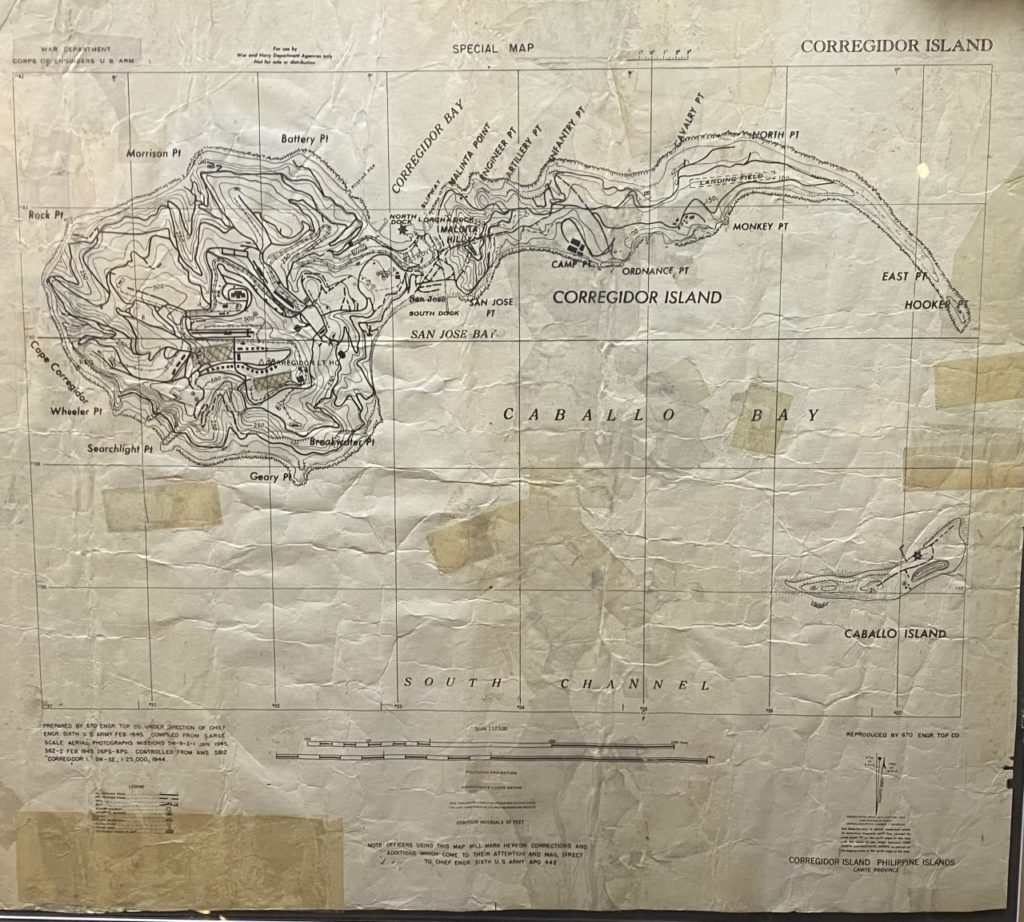
Map of Corregidor: Issued to officers and non-commissioned officers before Operation TOPSIDE, the airborne assault on Corregidor. The yellow highlights on this map show the drop zones for the operation. This map is on display in the ASOM’s Gallery.
The Battle
The drop at Corregidor began at 8:30 AM on February 16, 1945. In two lifts, 82 C-47’s of the 54th Troop Carrier Wing carried 2,050 men of the 503rd from Mindoro. The initial drops were made from an altitude of 650 feet, but this was soon reduced to 500 feet or less to minimize drift. The RCT included two battalions of the 503rd Parachute Infantry and its headquarters, engineer and service companies, and field artillery batteries of 75 mm howitzers from the 462nd Parachute Field Artillery.
The troops faced an estimated enemy defense of 850 (later proved to be over 5,000) in heavily fortified positions. The paratroopers completely surprised the defenders and speedily seized their first objective. By the end of February 16, they were firmly established on Topside, while the amphibious force was in control of Malinta Hill, the dominating terrain in the beachhead area. The 3rd battalion of the 34th Infantry, reinforced, had landed at San Jose beach that morning between the two airlifts and secured the hill after suffering heavy casualties from land mines on the beach. With the two successes of the 16th, the assault phase was complete, but many Japanese survivors hid in the Malinta Tunnel for safety.
Ironically, the tunnel, 1,400 feet long and dug deep in the heart of Corregidor, had served as MacArthur’s headquarters and a U.S. supply depot before the American defeat there. MacArthur feared the Japanese soldiers could sit there for months. The garrison had no such intention, though, and ignited a nearby ammunition dump—an act of defiance, and possibly of mass suicide. Most of the Japanese were killed in the explosion, along with 52 Americans. Those Japanese who survived the blast were forced out into the open and decimated by the Americans.
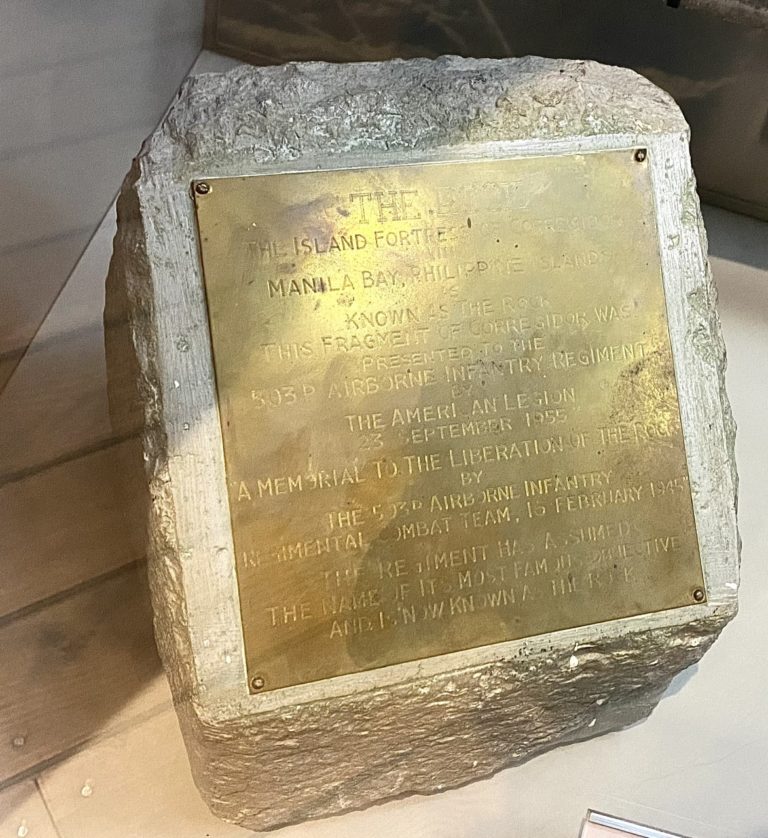
The Rock: A piece fo the rocky surface of Corregidor Island was taken as a souvenir of this famous
combat assault. This artifact is displayed in the Gallery of the ASOM.
The Outcome
By February 27, the Americans had killed about 4,500 Japanese and captured 19. Corregidor was officially in American hands by early March, but not without loss. The Americans suffered more than 1,000 casualties by March 2, including 210 deaths.
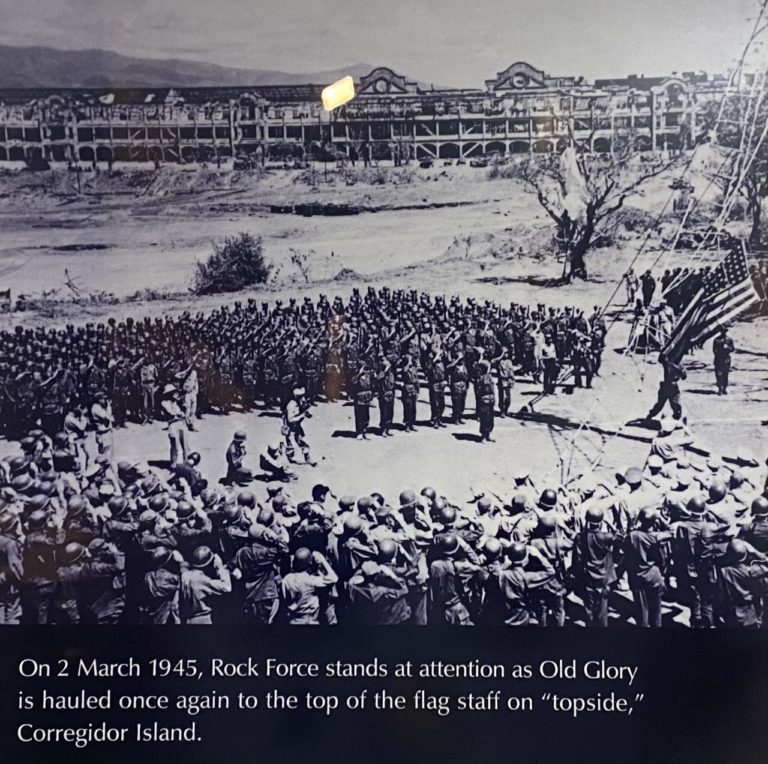
General MacArthur inspected the 503rd on March 2, 1945. After Congratulating the troops on their victory, he said, “I see that the flagpole still stands…. Hoist the colors to its peak and let no enemy ever haul them down.”
The Rock Regiment
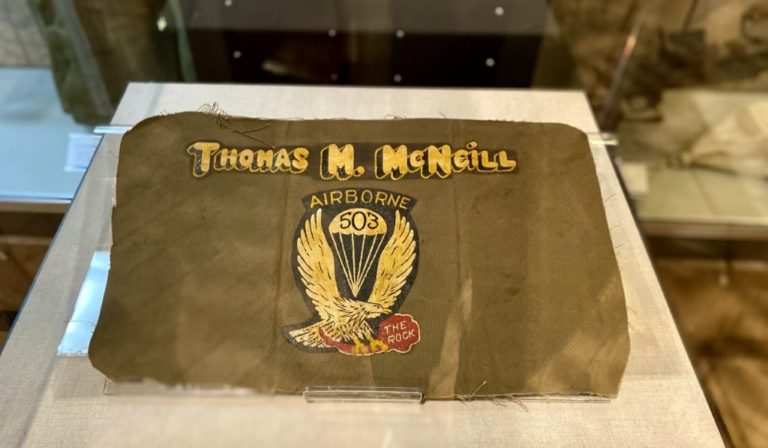
Following the successful recapture of Corregidor, the 503rd Regimental Combat Team earned not only the Presidential Unit Citation, but also the nickname, “The Rock Regiment”. While convalescing on Minodoro Island after the battle, Private First Class Thomas McNeill painted this image on his duffel bag using Red cross provided paint. It became so beloved by his fellow Soldiers that it was adopted as the unofficial unit insignia. This artifact is in the ASOM’s collection.
Did you enjoy this content? If so, please consider giving a gift to the ASOM to help support our mission of keeping the legacy of Airborne and Special Operations Soldiers alive.
The Battle of Corregidor
Background: The Taking of Corregidor
In May 1942, Corregidor, a small rock island at the mouth of Manila Bay, remained one of the last Allied strongholds in the Philippines after the Japanese victory at Bataan. Constant aerial bombardment attacks by the Japanese ate away at the American and Filipino defenders.
The Allied troops could not hold the Japanese off any longer, so General Jonathan Wainwright, commander of the U.S. Armed Forces in the Philippines, offered to surrender Corregidor to Japanese General Masaharu Homma, but Homma wanted the complete, unconditional capitulation of all American forces throughout the Philippines. Wainwright had little choice given the odds against him and the poor physical condition of his troops—he had already lost 800 men. He surrendered on April 9, 1942, and all 11,500 surviving Allied troops were evacuated to a prison stockade in Manila.
Return to Corregidor: February 16, 1945
The Americans returned to the Philippines in full strength in October 1944, beginning with the recapture of Leyte, the Philippines’ central island. Following this victory was the return of General MacArthur and the struggle for Luzon and the race for Manila, the Philippine capital. One week into the Allied battle for Luzon, U.S. airborne troops parachuted onto Corregidor to take out the Japanese garrison there. This mission was called Operation TOPSIDE.
The 503rd Regimental Combat Team (RCT) successfully assaulted Corregidor “The Rock” on February 16, 1945. American forces had entered Manila on February 5, and while they were driving the Japanese out of the city, many enemy troops escaped across the bay to Bataan and Corregidor, scenes of American defeat in 1942. To secure these positions in the U.S., Sixth Army landed a force at Mariveles on the tip of Bataan, opposite Corregidor, on February 15, with a plan to advance and meet another force driving down the east coast of Bataan. The next day, it launched the airborne assault on Corregidor, followed by amphibious reinforcement.
Map of Corregidor: Issued to officers and non-commissioned officers before Operation TOPSIDE, the airborne assault on Corregidor. The yellow highlights on this map show the drop zones for the operation. This map is on display in the ASOM’s Gallery.
The drop at Corregidor began at 8:30 AM on February 16, 1945. In two lifts, 82 C-47’s of the 54th Troop Carrier Wing carried 2,050 men of the 503rd from Mindoro. The initial drops were made from an altitude of 650 feet, but this was soon reduced to 500 feet or less to minimize drift. The RCT included two battalions of the 503rd Parachute Infantry and its headquarters, engineer and service companies, and field artillery batteries of 75 mm howitzers from the 462nd Parachute Field Artillery.
The troops faced an estimated enemy defense of 850 (later proved to be over 5,000) in heavily fortified positions. The paratroopers completely surprised the defenders and speedily seized their first objective. By the end of February 16, they were firmly established on Topside, while the amphibious force was in control of Malinta Hill, the dominating terrain in the beachhead area. The 3rd battalion of the 34th Infantry, reinforced, had landed at San Jose beach that morning between the two airlifts and secured the hill after suffering heavy casualties from land mines on the beach. With the two successes of the 16th, the assault phase was complete, but many Japanese survivors hid in the Malinta Tunnel for safety.
Ironically, the tunnel, 1,400 feet long and dug deep in the heart of Corregidor, had served as MacArthur’s headquarters and a U.S. supply depot before the American defeat there. MacArthur feared the Japanese soldiers could sit there for months. The garrison had no such intention, though, and ignited a nearby ammunition dump—an act of defiance, and possibly of mass suicide. Most of the Japanese were killed in the explosion, along with 52 Americans. Those Japanese who survived the blast were forced out into the open and decimated by the Americans.
The Rock: A piece of the rocky surface of Corregidor Island was taken as a souvenir of this famous
combat assault. This artifact is displayed in the Gallery of the ASOM.
By February 27, the Americans had killed about 4,5000 Japanese and captured 19. Corregidor was officially in American hands by early March, but not without loss. The Americans suffered more than 1,000 casualties by March 2, including 210 deaths.
General MacArthur inspected the 503rd on March 2, 1945. After Congratulating the troops on their victory, he said, “I see that the flagpole still stands…. Hoist the colors to its peak and let no enemy ever haul them down.”
Following the successful recapture of Corregidor, the 503rd Regimental Combat Team earned not only the Presidential Unit Citation, but also the nickname, “The Rock Regiment”. While convalescing on Mindoro Island after the battle, Private First Class Thomas McNeill painted this image on his duffel bag using Red cross provided paint. It became so beloved by his fellow Soldiers that it was adopted as the unofficial unit insignia. This artifact is in the ASOM’s collection.
Did you enjoy this content?
If so, please consider giving a gift to the ASOM to help support our mission of keeping the legacy of Airborne and Special Operations Soldiers alive.
Museum Exhibits
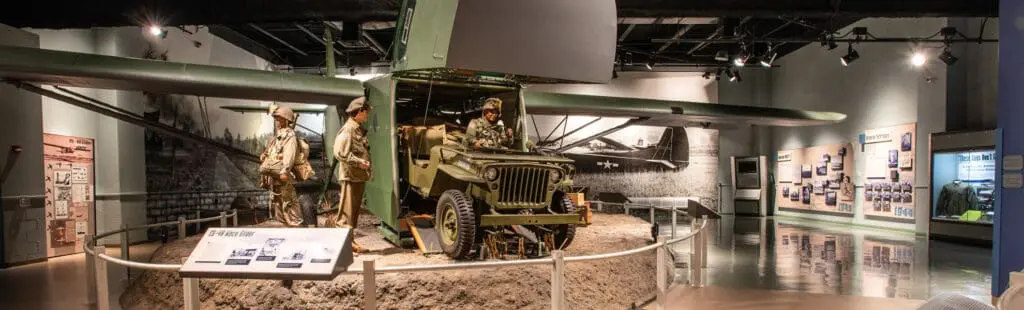
The U.S. Army Airborne and Special Operations Museum honors the courage of Soldiers from the 1940 Parachute Test Platoon to today’s Global War on Terror. The museum preserves their extraordinary feats and shares the stories of America’s Airborne and Special Operations Forces who “jump into battle.” It stands as a source of pride for all who have served and continue to serve.
Journey through history beginning with the first Parachute Test Platoon in 1940 and ending with today’s Airborne and Special Operations units. From World War II to the Cold War and beyond, the exhibits show how courage and dedication have defined every generation of Soldiers.
EARLY AIRBORNE
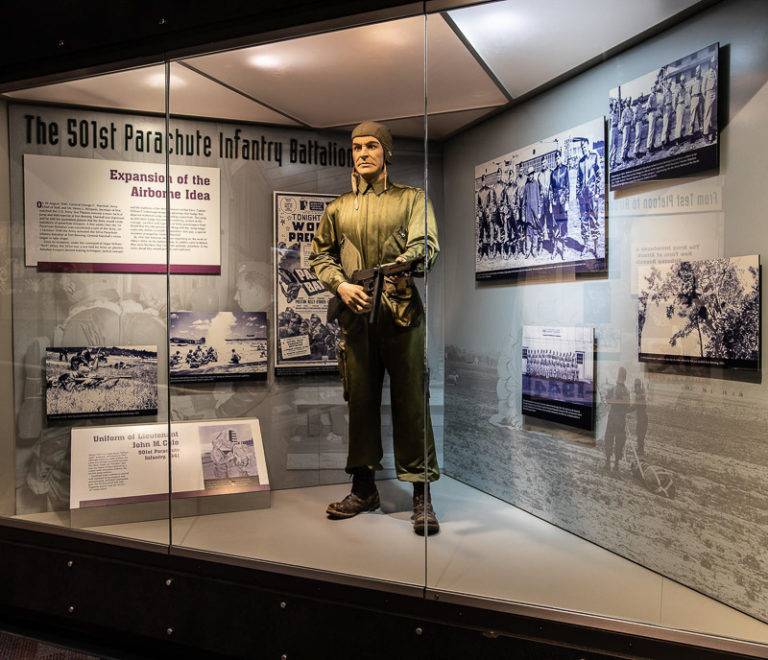
On August 16, 1940, the first U.S. Soldiers leapt into history, creating the American paratrooper. Led by Lt. Bill Ryder and Pvt. William King, these pioneers—joined by legends like Bud Miley, Bill Yarborough, and Maj. Gen. William C. Lee, the “Father of the U.S. Airborne”—transformed a bold experiment into a powerful new force of war. Their story begins here.
WORLD WAR II
World War II was the proving ground of the Airborne. Five divisions—alongside Rangers, OSS, and the 1st Special Service Force—spearheaded daring missions from Sicily to Normandy to Corregidor, shaping victory in Europe and the Pacific.
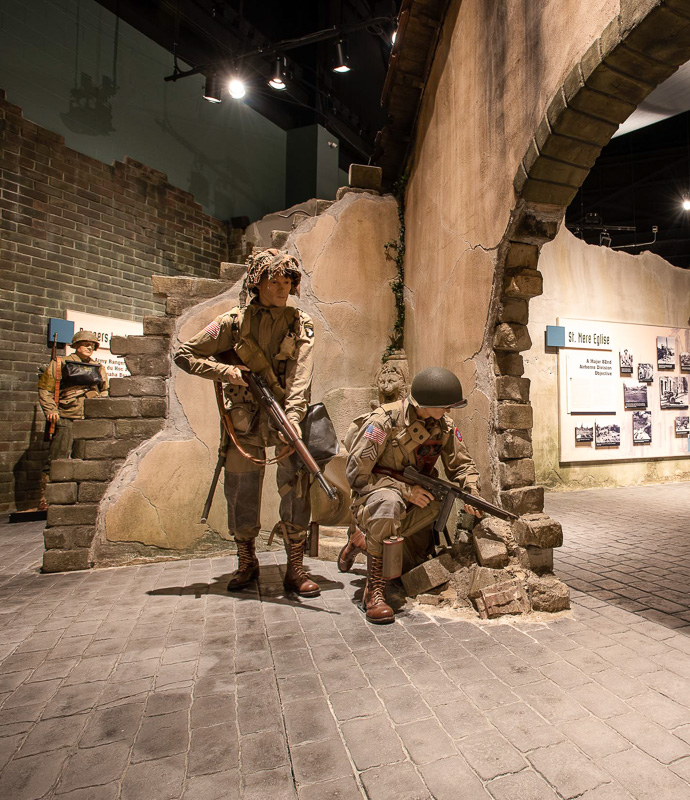
Step into a French village on D-Day, where paratroopers leap into the night sky and C-47 “Skytrains” roar overhead. Walk war-torn streets marked by bullet holes, then cross into the Pacific Theater through immersive displays and rare wartime footage. Among the highlights is one of the world’s finest restored WACO CG-4A gliders—a fragile craft once flown by the thousands into battle.
KOREA AND COLD WAR
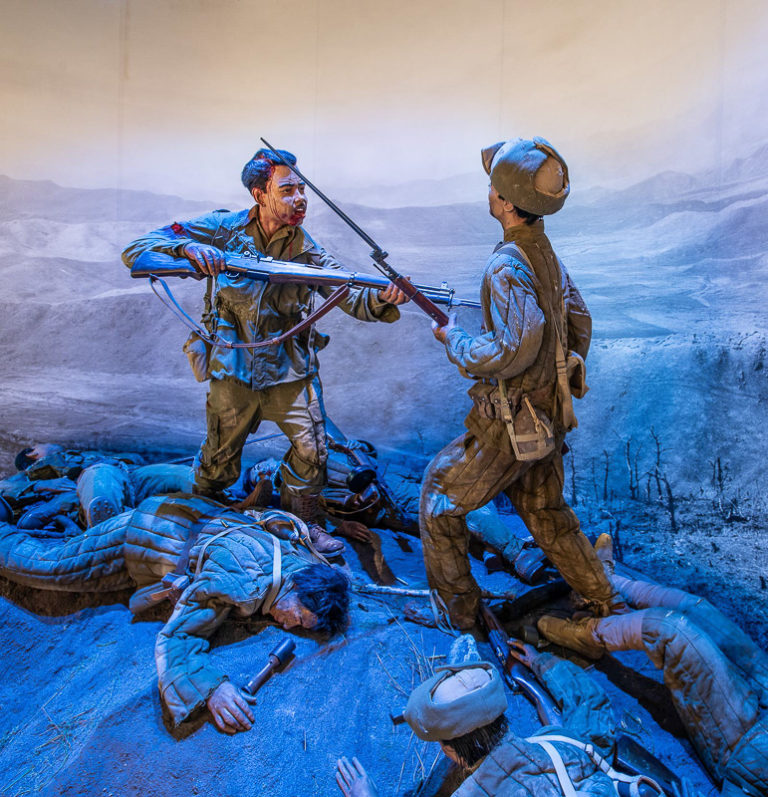
After WWII, a new fight emerged—the global spread of communism. While the U.S. and Soviet Union waged a tense Cold War, “hot” battles broke out in Korea.
In 1950, the 187th Airborne Regimental Combat Team leapt into action with daring parachute assaults, including Operation TOMAHAWK in 1951. Visitors can stand alongside Medal of Honor recipient Corporal Rudy Hernandez, who fought against overwhelming odds to save his fellow paratroopers.
The Korean War also gave rise to new elite forces. The Eighth Army Ranger Company became the model for modern Rangers, including the historic 2nd Rangers—the only African American Ranger unit in U.S. history. That same year, the 10th Special Forces Group was established at Fort Bragg, laying the foundation for today’s Special Forces.
Another covert unit, the “White Tigers” (8240th Army Unit), operated deep inside North Korea, leading partisan fighters in raids, rescues, and sabotage missions so secret they weren’t revealed until decades later.
THE HOMEFRONT: CIVIL UNREST
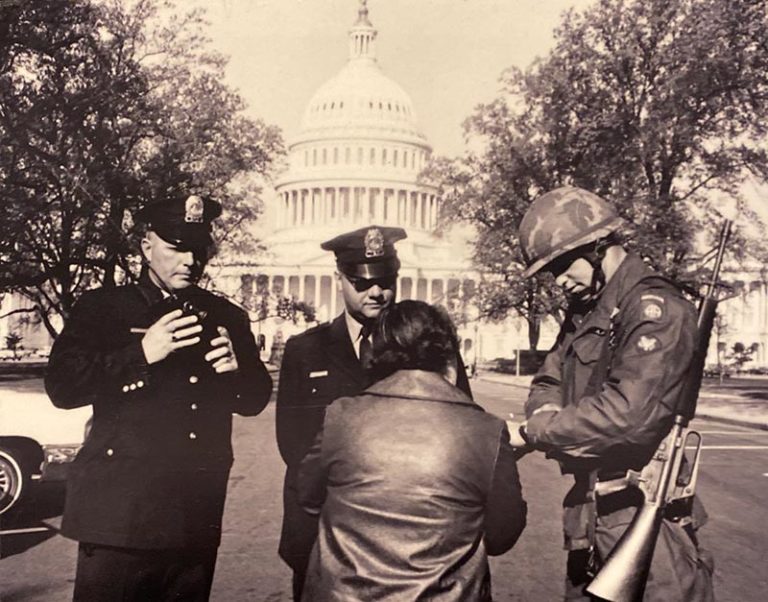
During the Cold War, unrest wasn’t only abroad—it was felt at home. Airborne units were deployed to American cities from Miami to Detroit to restore order during times of crisis.
In 1965, the 82nd Airborne and 7th Special Forces Group joined international partners in the Dominican Republic, leading the largest overseas deployment since WWII. This peacekeeping mission captured the nation’s attention even as another conflict—the war in Vietnam—was escalating.
VIETNAM
In Vietnam, Airborne and Special Forces units faced one of the most challenging wars in U.S. history. The 101st “Screaming Eagles,” the 82nd, the 173rd “Sky Soldiers,” and Green Berets fought with courage in brutal jungles, often alongside indigenous allies.
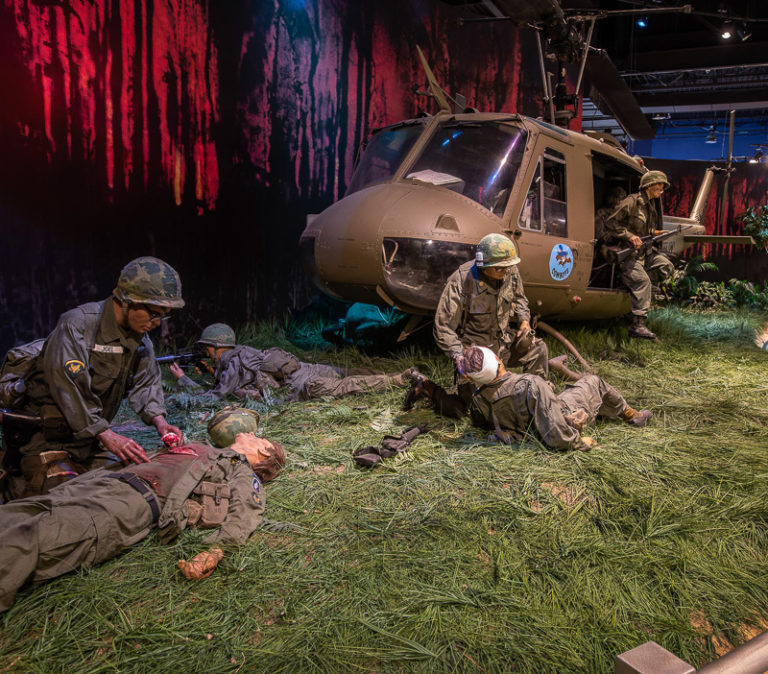
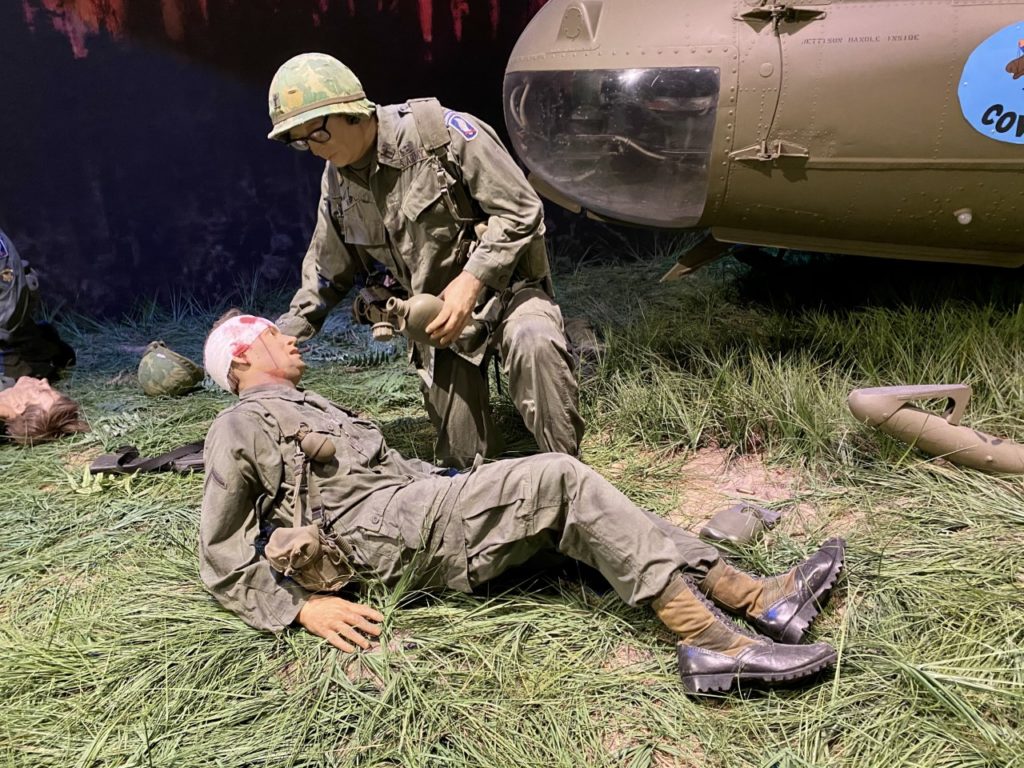
At the center of this exhibit is a UH-1 “Huey” helicopter, frozen in action with its pilot at the controls, gunner ready, and paratroopers on the ground. Around it, powerful stories of heroism come to life:
- Specialist Lawrence Joel, a medic with the 173rd, treated thirteen wounded Soldiers under heavy fire during Operation HUMP—despite being shot twice himself. His bravery earned him the Medal of Honor and the nation’s gratitude.
- Chaplain Charles Watters, serving with the 173rd, ministered to Soldiers in the heat of battle. He gave last rites under fire and was ultimately killed while rescuing the wounded—earning him a posthumous Medal of Honor.
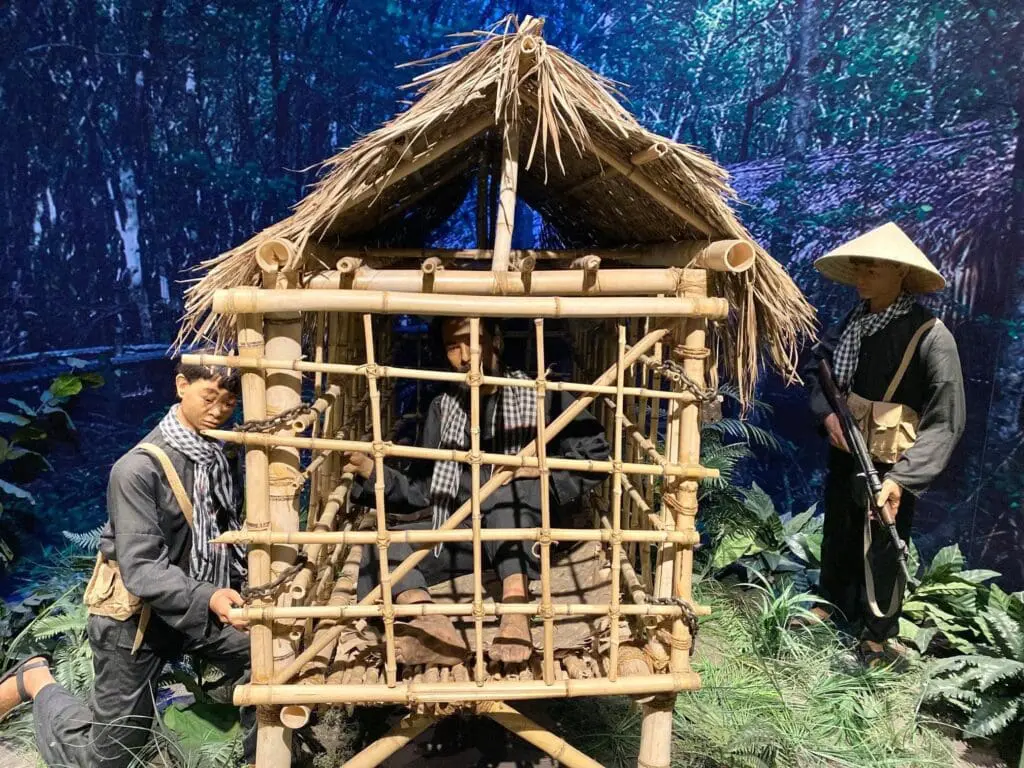
- 1LT James “Nick” Rowe, a Green Beret, endured five years as a POW in the “Forest of Darkness” before escaping. His survival experience shaped the Army’s SERE training, still used by Special Forces today.
From helicopter assaults to covert reconnaissance, the Vietnam exhibit immerses visitors in the courage, sacrifice, and resilience of Soldiers who carried the fight in a war without front lines.
CONTINGENCY OPERATIONS & TRAINING
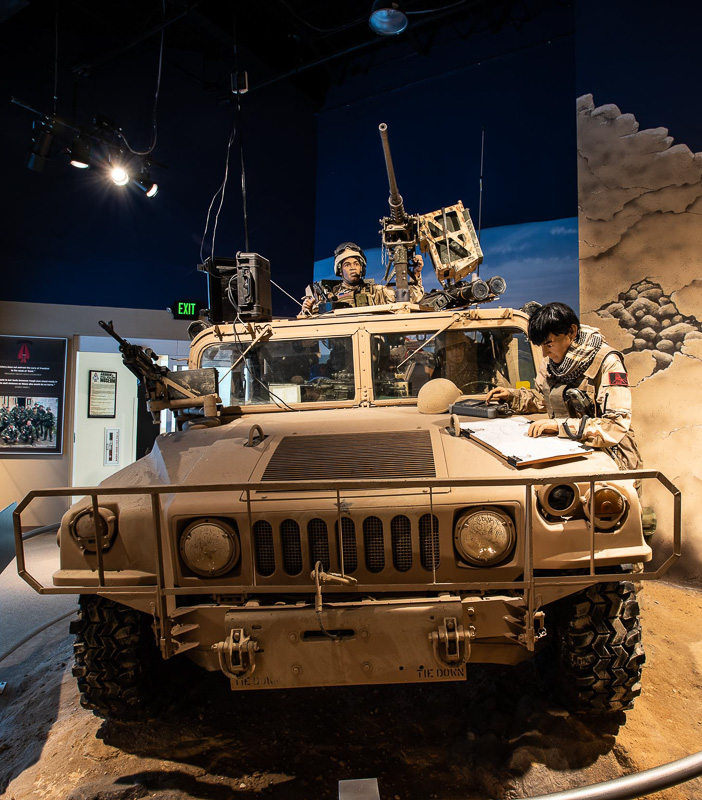
Since Vietnam, U.S. Airborne and Special Operations forces have led missions across the globe—from Grenada to Panama to the Persian Gulf—shaping America’s rapid-response power.
One of the most daring moments came during Operation JUST CAUSE in Panama, 1989. Special Operations “Little Birds” landed on a prison rooftop under fire, freed an American hostage in just six minutes, and escaped through a hail of bullets. Nearby, the lightweight but powerful Sheridan tank—air-dropped into combat—smashed through roadblocks and enemy strongholds. The very Sheridan on display fought in Panama and later rolled into the Saudi desert to face Iraq in 1990.
GLOBAL WAR ON TERRORISM
When the Soviet Union collapsed, a new threat rose—Islamic extremism. On September 11, 2001, terrorists struck the World Trade Center, the Pentagon, and attempted the U.S. Capitol, killing nearly 3,000 people.
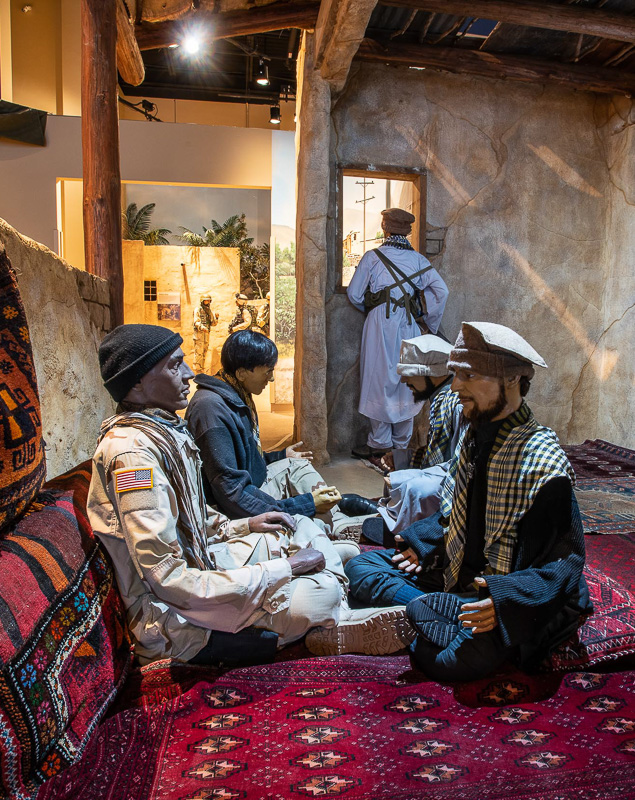
In response, Special Forces became America’s “weapon of choice.” Partnering with the Northern Alliance in Afghanistan, they toppled the Taliban and dismantled Al-Qaeda strongholds. Task Force DAGGER led the first waves of Operation Enduring Freedom, proving the speed and precision of U.S. Special Operations.
At the museum, visitors step inside an Afghan hut to see how a handful of Green Berets worked with local fighters to change the course of history—and how America’s Airborne and Special Operations Forces continue the fight against terrorism today.
Counterattack in the Pacific: Action in New Guinea and the Philippines
American parachute forces in the Pacific Theater of Operations were first used in New Guinea where the Allies mounted a major counteroffensive to stop the Japanese advance on Australia. On September 5th, 1943, the 503rd Parachute Infantry Regiment completely surprised the Japanese by dropping the 1,700 troopers on the enemy airfield at Nadzab. Following the 82nd Airborne Division’s jump into Sicily, Nadzab had none of the problems of that operation, and Army planners fully acknowledged the usefulness of airborne assaults.
The 503rd jumped again on July 3rd and 4th, 1944 at Noemfoor Island in New Guinea as an airborne reinforcement, helping to defend the Kamiri airstrip against Japanese counterattacks. After that operation, the 503rd moved to the Philippine Islands where, on February 16th, 1945, the regiment made its celebrated jump onto Corregidor Island in Manilla Bay. The battle of “The Rock” was legendary, with Colonel George Jones’ 503rd Regimental Combat Team pitted against over 5,000 Japanese defenders.
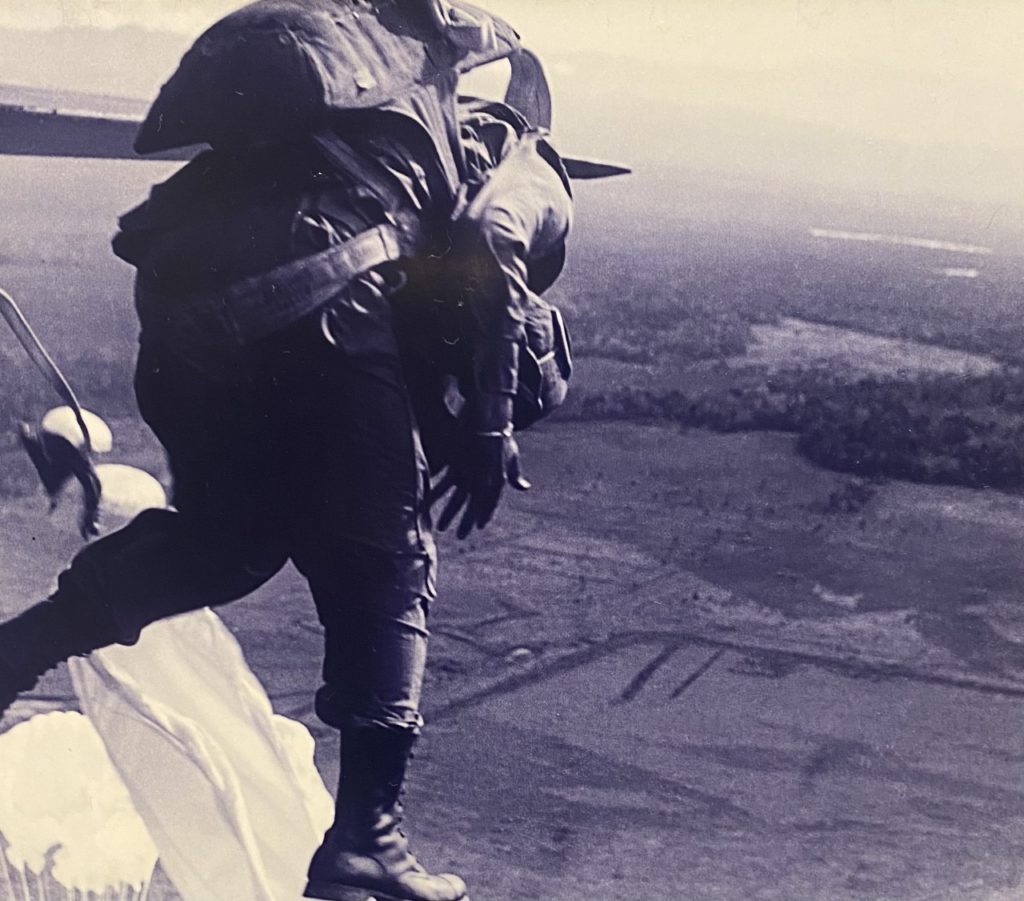
Moment of truth: A 503rd paratrooper begins his descent into combat, Noemfoor Island, July 3, 1944.
Joining the 503rd in the fight for the Philippines, Major General Joe Swing’s 11th Airborne Division distinguished itself through assault jumps and seaborne landings. Swing’s troopers jumped at Tagaytay, Luzon, on February 3rd, 1945, seized the prison camp at Los Banos, Luzon, on February 23rd, 1945 and made a parachute and glider assault at Aparri, Luzon on June 23rd, 1945. After the Japanese surrender, the 11th headed to Japan as an occupying force.
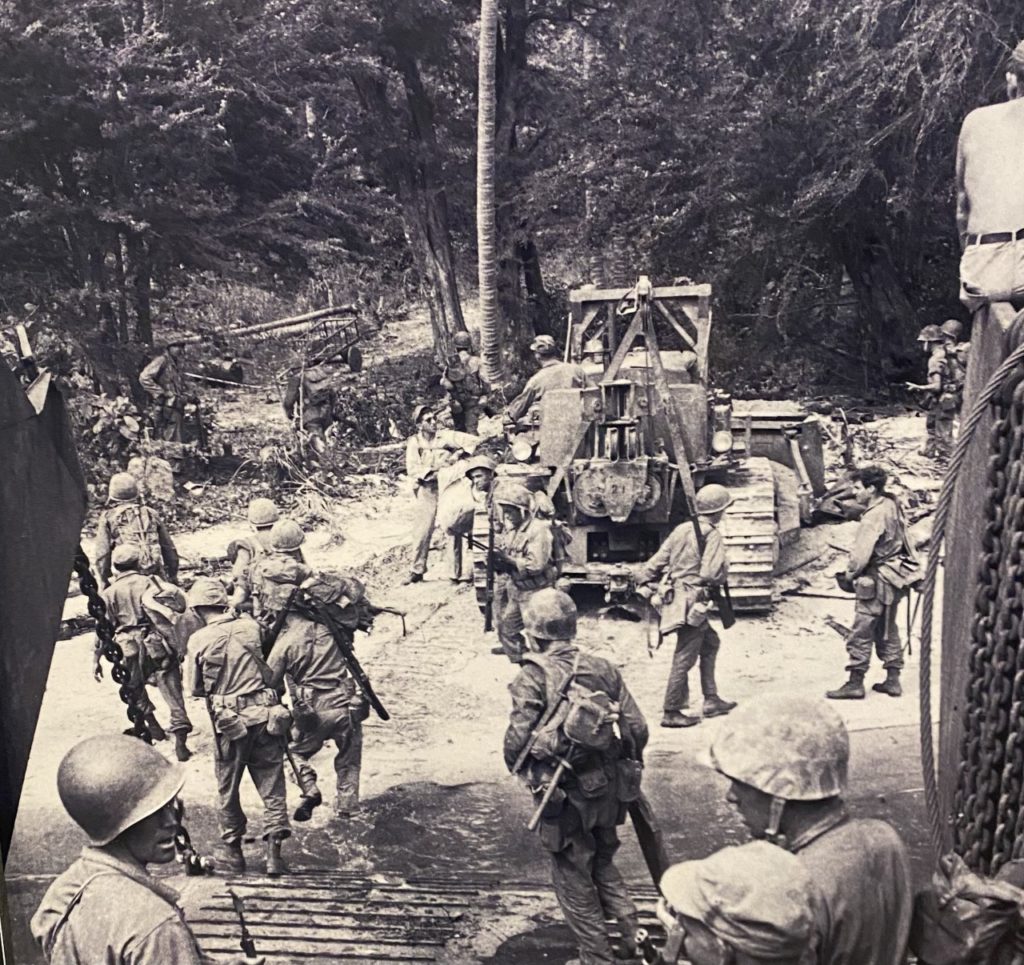
Men of B and E company, 6th Ranger Infantry Battalion, follow a bulldozer ashore on a southern coast of Santiago Island, Luzon, the Phillipines
Special Operations Forces also played a part in the Philippines. In January 1945, the Alamo Scouts of the U.S. Sixth Army assisted the 6th Ranger Battalion in the dramatic seizure of the Cabanatuan prisoner of war camp. As with the Airborne operations, surprise, courage and fighting skills rapidly defeated the Japanese.
Did you enjoy this content?
If so, please consider giving a gift to the ASOM today to help us continue our mission of educating the public on the legacies of Airborne and Special Operations Soldiers.
Pearl Harbor: A Day of Infamy
“Yesterday, December 7,1941, a date which will live in infamy, the United States of America was suddenly and deliberately attacked by naval and air forces of the Empire of Japan” President Franklin D. Roosevelt to Congress – December 8, 1941
Japan Attacks in the Pacific
Japan’s sudden and brutal attack against the American naval base at Pearl Harbor, Hawaii, on Sunday, December 7, 1941 left most of the Pacific fleet in ruins and 2,403 servicemen dead, including 1,103 entombed in the battleship Arizona. With American military power temporarily blunted, Japan was free to move military forces across Southeast Asia and the Pacific basin, quickly conquering Malaysia, Burma, the Philippines, parts of New Guinea and a host of small islands. By June 1942, Japan ruled much of the Asiatic-Pacific region and her naval and air forces lurked at the gates of Australia.
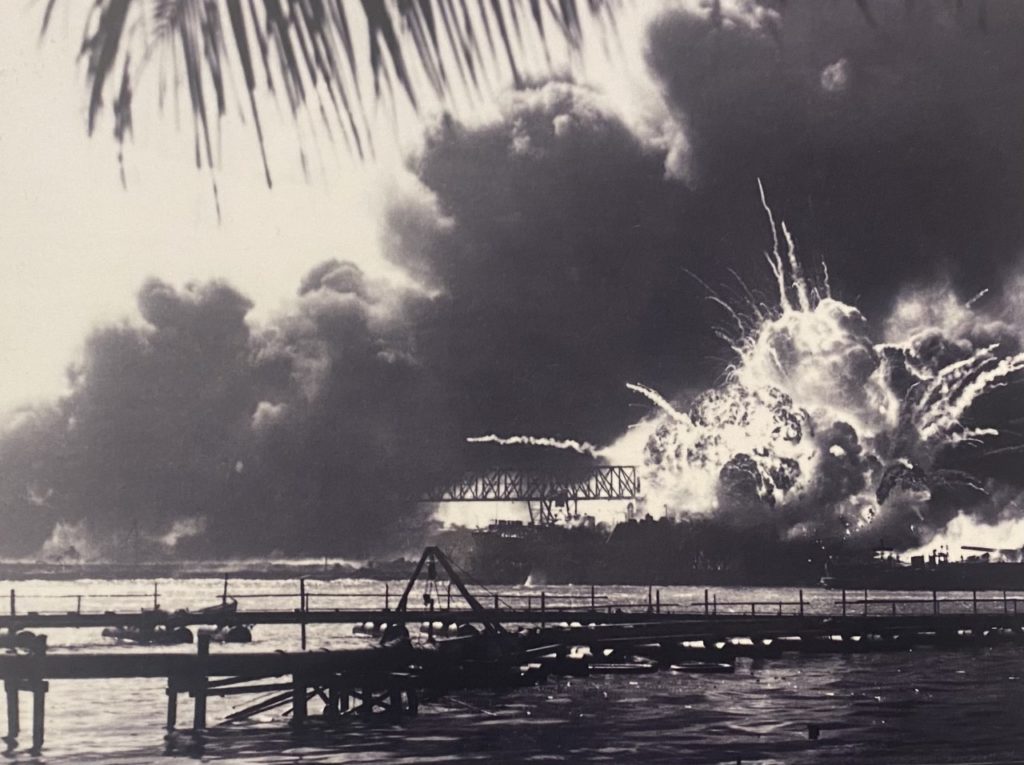
Pearl Harbor, Hawaii, December 7, 1941. The USS Shaw explodes during the surprise Japanese attack.
Adolf Hitler was impressed with the Pearl Harbor attack, so much so that Germany declared war on the United States on December 11, 1941, immediately dispatching submarines to attack ships along the U.S. coast. Hitler’s action guaranteed that America would fight in Europe as well as the Pacific, and although the situation in early 1942 was grim for the Allies, time would bring the “inevitable victory” that President Roosevelt promised on December 8, 1941, before a joint session of Congress. The Japanese offensive in the Pacific came to an abrupt end on June 4, 1942 near the tiny island of Midway. There, the U.S. Navy destroyed the pride of Japan’s Navy , a force of four aircraft carriers bearing 270 aircraft. Pearl Harbor was avenged, at least in part, and America was prepared to counterattack. Army parachute, glider and Special Operations forces would join in the march across the Pacific to defeat Japan.
Joining the Pacific counteroffensive were the 503rd Parachute Infantry Regiment, 11th Airborne Division, Detachment 101 of the Office of Strategic Services (OSS), Merrill’s Marauder’s, 6th Ranger Battalion and Alamo Scouts. The 503rd conducted important parachute assaults in New Guinea, and most notably, at Corregidor Island in the Philippines. Major General Joe Swing’s 11th Airborne Division made parachute, glider and seaborne assaults in the Philippines. “Det 101” and Merrill’s Marauder’s attacked the Japanese Army in the jungles of Burma, effectively blunting the enemy’s offensive capabilities.
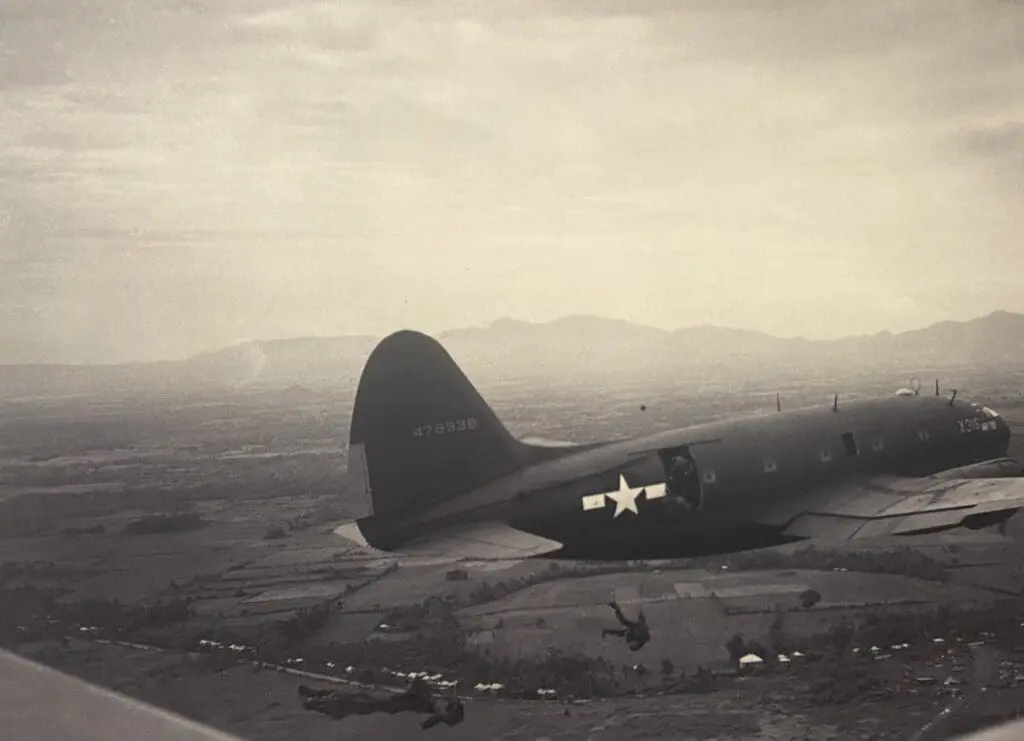
Paratroopers of the 511th Parachute Infantry Regiment, 11th Airborne Division, jump toward a drop zone in the Phillipine Islands.
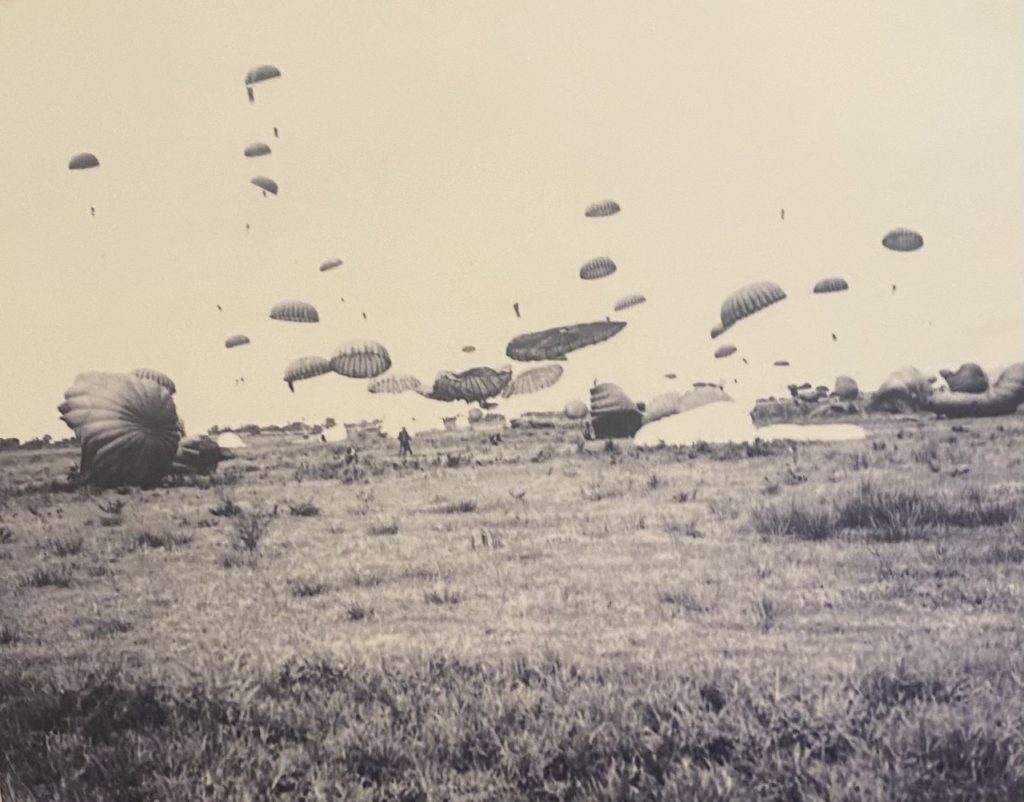
Paratroopers of the 503rd Regimental Combat Team descend on Japanese defenses.
Did you enjoy this content?
Please consider giving a gift to the ASOM so the legacies of Airborne and Special Operations Soldiers can stay alive for generations to come.