
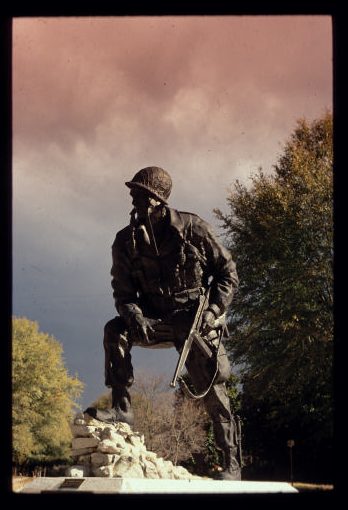
Today, September 23, marks sixty-five years since Fort Bragg pulled the cover off its most recognizable Soldier. He has never fired a shot, never made a jump, and never said a word. Yet two generations of paratroopers have touched his boot for luck on the way to something harder. Soldiers never used his official name, “The Airborne Trooper.” They called him Iron Mike, and it stuck so completely that most people today have no idea he was ever called anything else.
A General’s Idea
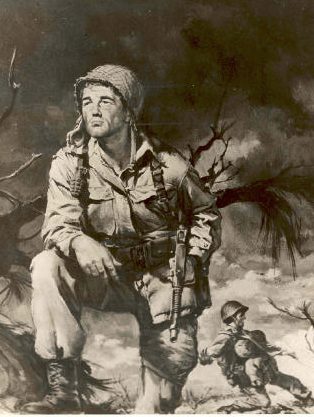
The statue began as an idea, not an order. Sometime in the 1950s, Brigadier General Robert F. Sink, commander of the XVIII Airborne Corps and Fort Bragg and himself a legendary regimental commander from World War II, decided the post needed a monument worthy of the men who jumped out of its airplanes. He wanted something that looked like the cover art of Those Devils in Baggy Pants, Ross Carter’s memoir of the 504th Parachute Infantry Regiment. The book took its title from an unfinished letter found in a dead German officer’s pocket, describing American paratroopers who “kept coming” no matter what: devils in baggy pants who could not be stopped.
That was the spirit General Sink wanted standing at the gates of Fort Bragg.
Building The Airborne Trooper
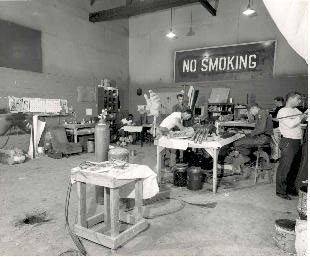
The project got underway in May 1960 under Major Earl Peterson, who traveled to Fort Benning to study how Georgia had built its own “Infantryman” statue before settling on a plan, a budget, and a building. That building, a World War II–era vehicle maintenance shop numbered 10-1541, had the tall ceilings and north-facing windows a fifteen-foot statue would need. It still stands on Longstreet Road today, now the practice hall for the 82d Airborne Division Band.
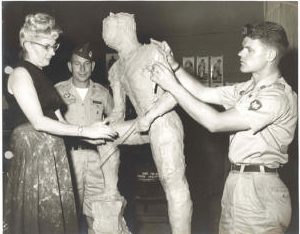
The crew that gathered there was almost entirely made of people learning as they went. Leah Hiebert, an Army wife who taught art classes on post and had just finished a bust of General Sink, led the sculpting. Private First Class Zintars Zamelis, a fiberglass technician with the 82d’s parachute maintenance company, ran the construction side. Specialists Janis Krisans and Kenneth Knutson built the clay models, and welder Kenneth LeClaire joined later to raise the steel frame. Together they built three separate eighteen-inch clay studies before General Sink chose the one he liked, and Sergeant Major James L. Runyon, in his own World War II uniform, spent weeks posing for the four-foot guide model that the full-size statue was built around.
What came out of Building 10-1541 that November was a steel-beam-and-wire-mesh giant wrapped in fiberglass, epoxy, hardener, and bronze powder: fifteen feet tall, 3,235 pounds, one foot planted on a pile of rocks as though he’d just landed there.
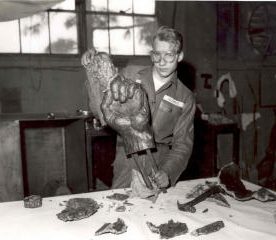
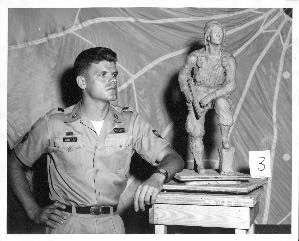
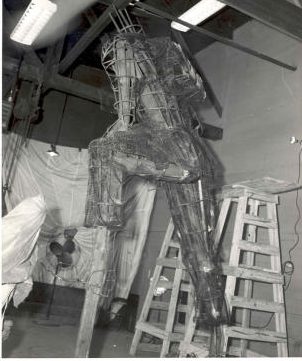
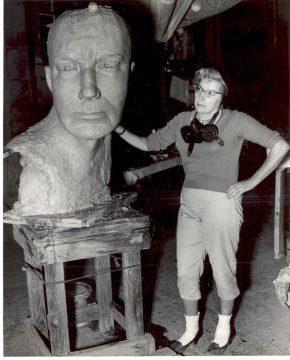
“This magnificent statue… stands as a tribute to that special spirit and indomitable courage which marks the Airborne Trooper as among the world’s finest combat Soldiers, a Soldier who sought to do a little more, to do it a little better, to dedicate himself to the finest ideals of the United States Army.” General Thomas J. H. Trapnell · Dedication Address, September 23, 1961
An Icon Unveiled
Getting the statue out of the shop turned out to be its own small battle: the door was too narrow, and the Post Engineer had to open up part of the wall to move him. Wrapped in mattresses and crated onto a lowboy truck, Iron Mike traveled under military escort to the intersection of Bragg Boulevard and Knox Street, where he was hoisted onto a twelve-foot pyramid base and covered in a parachute to wait for his big day.
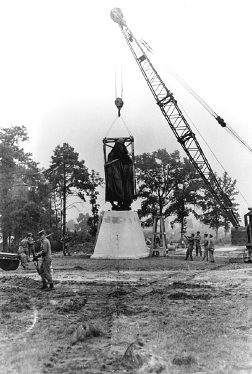
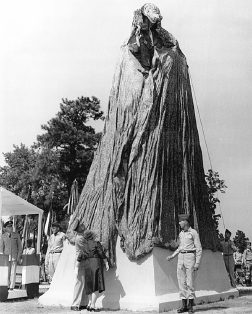
That day came on September 23, 1961. About a thousand people turned out, including North Carolina Governor Terry Sanford, Fayetteville Mayor Robert Butler, three former commanders of the XVIII Airborne Corps, and Mrs. William C. Lee, widow of the man known as the Father of Airborne. General Trapnell delivered the dedication address above, and then Mrs. Lee pulled the ripcord herself. As the parachute fell away, four howitzers fired a 21-gun salute and the 82d Airborne Division Band played the national anthem.
From “Devil in Baggy Pants” to Iron Mike
The statue went through three names before Soldiers settled the matter for good. Early on, it was simply Devil in Baggy Pants, after the book that inspired it, but Corps staff worried that name honored only the 504th, when the whole point was to honor every airborne trooper. So the plaque at its base reads instead: “Iron Mike, in honor of Airborne Troopers whose courage, dedication, and traditions make them the world’s finest fighting Soldiers.”
“Iron Mike” wasn’t even in the room that day. The nickname appeared on its own, in barracks conversation, sometime after the unveiling, and by the time anyone thought to write it down, it had already won. It isn’t a portrait of any one Soldier, and Fort Bragg’s isn’t the only one wearing the name: a French memorial called Iron Mike stands today at La Fière, near Sainte-Mère-Église, honoring the paratroopers who died liberating Normandy. It was dedicated in 1997 and remains a fixture of D-Day remembrances there every June.
From the Traffic Circle to the Museum
Standing at the edge of Bragg Boulevard made Iron Mike easy to see, and, it turned out, just as easy to reach. Repeated vandalism forced his relocation in 1979 to a quieter traffic circle between the Officers’ Club and Post Headquarters, minus the twelve-foot pyramid base he’d stood on since 1961.
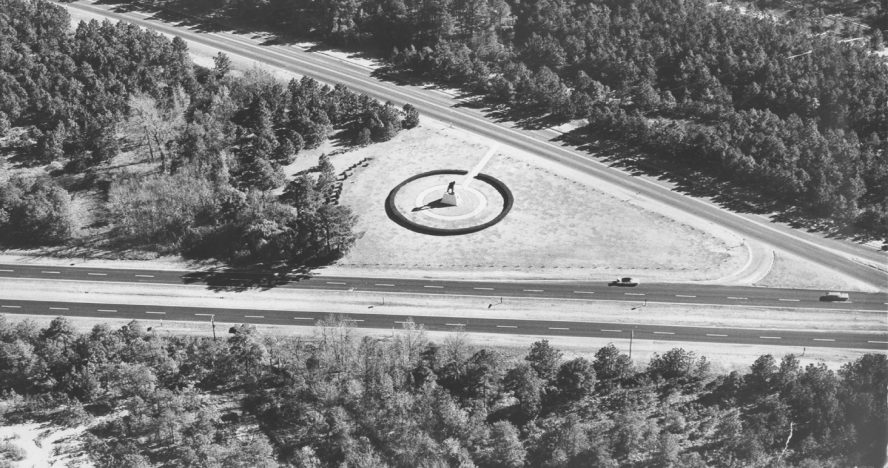
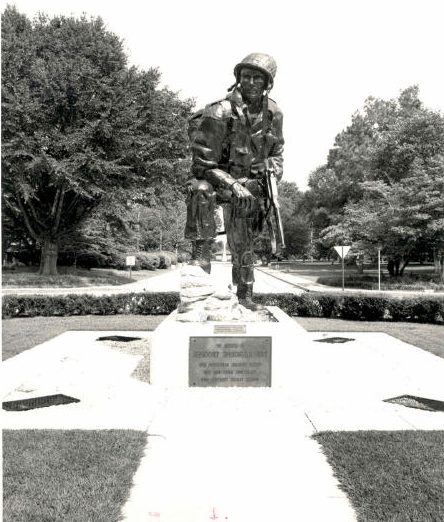
Decades of North Carolina weather eventually caught up with the fiberglass original. In 2005, Fort Bragg dedicated a new bronze Iron Mike to stand permanent watch at the traffic circle, freeing the 1961 statue for a well-earned restoration. That original trooper, the one Leah Hiebert and her crew built by hand in Building 10-1541, went on display at the U.S. Army Airborne & Special Operations Museum in downtown Fayetteville in 2010, and was refurbished again in 2021. He still stands watch there today, welcoming every visitor who walks through the Museum’s doors.
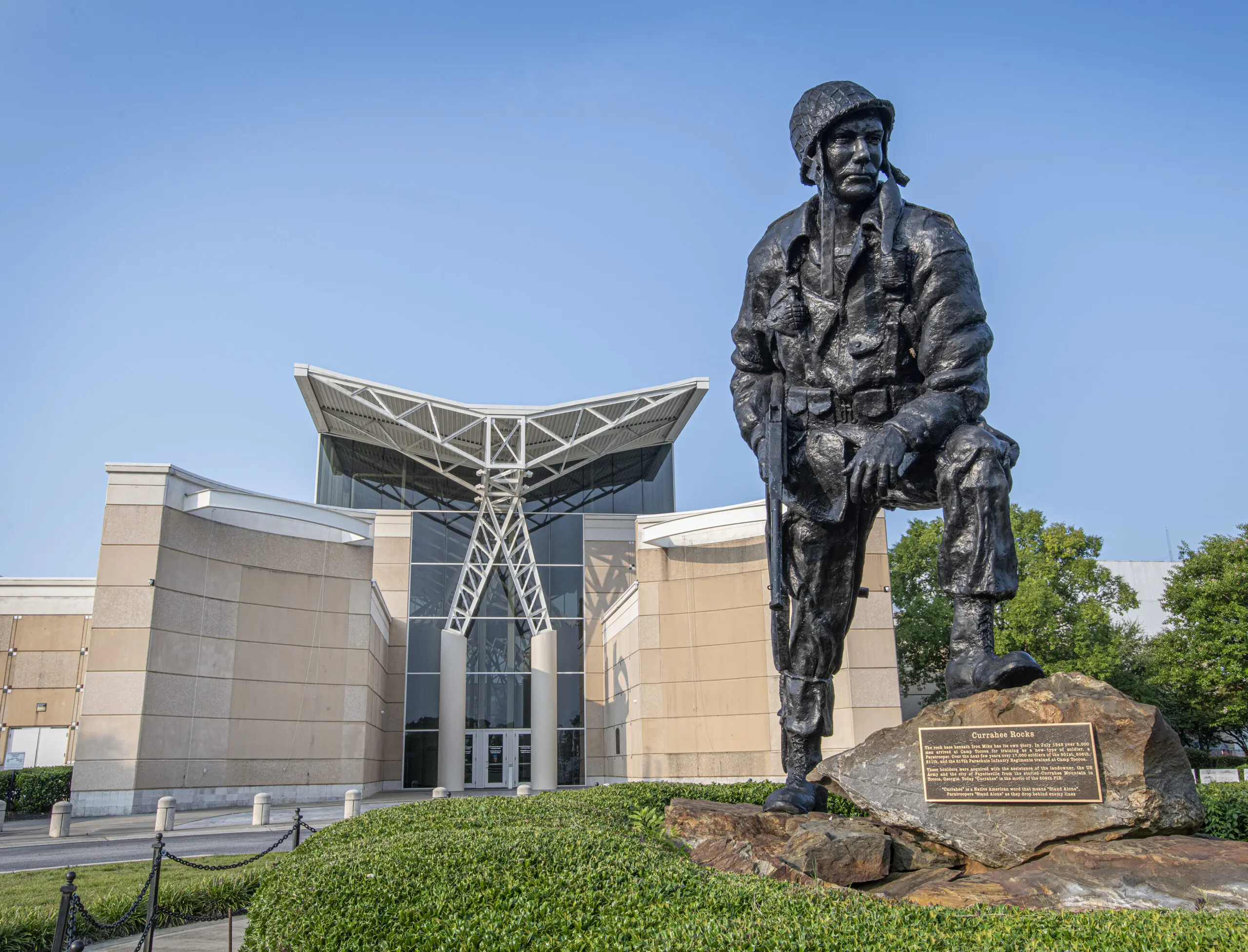
Iron Mike’s Journey
He was never meant to be a portrait of any single Soldier. That was the point from the start. Iron Mike is every trooper who ever checked his equipment one more time before the green light, and that is exactly why he has outlasted his own fiberglass, his own traffic circle, and everyone who built him. Sixty-five years on, he’s still doing what General Trapnell said he would: standing for the Soldier who does a little more, and does it a little better.
Come see him this week. Tell us what Iron Mike means to you. We’d love to share your story.